Card shuffling in casinos serves two purposes. First, to randomize the deck. Second, to prevent cheating.
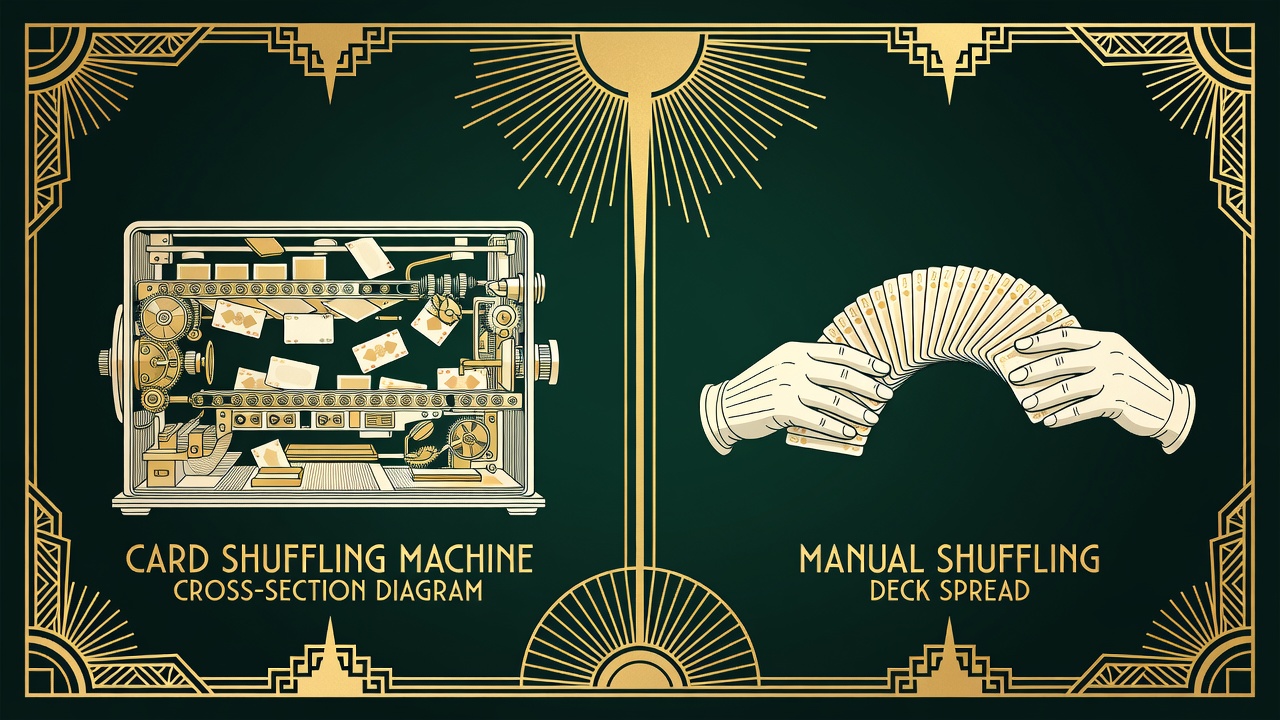
Two methods exist: continuous shuffling machines (CSMs) and manual shoes.
Manual Shoes
A manual shoe is a device that holds six or eight decks of cards. The dealer removes cards from the shoe one at a time and deals them to players.
Between rounds, the dealer shuffles the remaining cards by hand. This requires skill. A good shuffle takes fifteen to thirty seconds.
A manual shoe requires periodic reshuffles. After a certain amount of penetration (typically 75 percent of the deck is dealt), the cards are reshuffled.
Continuous Shuffling Machines
A continuous shuffling machine (CSM) is a device that constantly shuffles cards. After a card is dealt, it goes into the CSM. The CSM randomizes it back into the deck.
No periodic reshuffles are needed. The deck is always in flux.
The Regulatory Framework
Regulators in different jurisdictions have different rules about shuffles. The Nevada Gaming Control Board specifies shuffling requirements. The Malta Gaming Authority specifies different requirements.
Generally, manual shoes are acceptable if the shuffle is adequate. CSMs are acceptable if they function properly.
The Advantage for the Casino
CSMs prevent card counting. A counter needs to track which cards have been dealt. With a CSM, the cards that have been dealt go back into the deck. The counting advantage is eliminated.
From a casino perspective, CSMs are superior because they prevent one form of advantage play.
Manual shoes allow card counting if the penetration is deep enough. Therefore, casinos using manual shoes typically deal to only 75 percent penetration before reshuffling.
The Player Perspective
Players often dislike CSMs because they associate them with worse odds. This is not necessarily true. The house edge is the same whether the shuffle is continuous or periodic.
But the psychological feel is different. With a manual shoe, a player can track the cards to some extent. With a CSM, no tracking is possible.
This perception may affect player behavior. Some players might play more aggressively at a manual shoe table thinking they have an edge.
The Cheating Prevention
Manual shuffles are vulnerable to false shuffles, where the dealer appears to shuffle but does not randomize the deck. A good shuffle prevents this.
CSMs eliminate the risk of false shuffles because the machine, not the dealer, is randomizing.
Regulators watch dealers carefully to ensure proper shuffles. But the mechanical guarantee of a CSM is cleaner.
The Practical Differences
Manual shoes are slower. A shuffle takes time. This reduces the number of hands dealt per hour.
CSMs are faster. Hands are dealt quicker. More money cycles through the table.
From a revenue perspective, casinos prefer CSMs because they increase hands per hour.
The Standards
The Shuffle Master company manufactures most CSMs used in casinos. The devices are certified and tested regularly.
Manual shuffles are done by dealers according to established procedures. The quality varies. A sloppy shuffle is worse than a good CSM.
The Conclusion
Both methods are acceptable. Both have regulatory approval. The choice depends on casino preference and operational considerations.
For players, the difference is minimal from a mathematical perspective. The house edge is set by the game rules, not by the shuffle method.
From a game integrity perspective, CSMs provide greater assurance because the randomization is mechanical and constant.