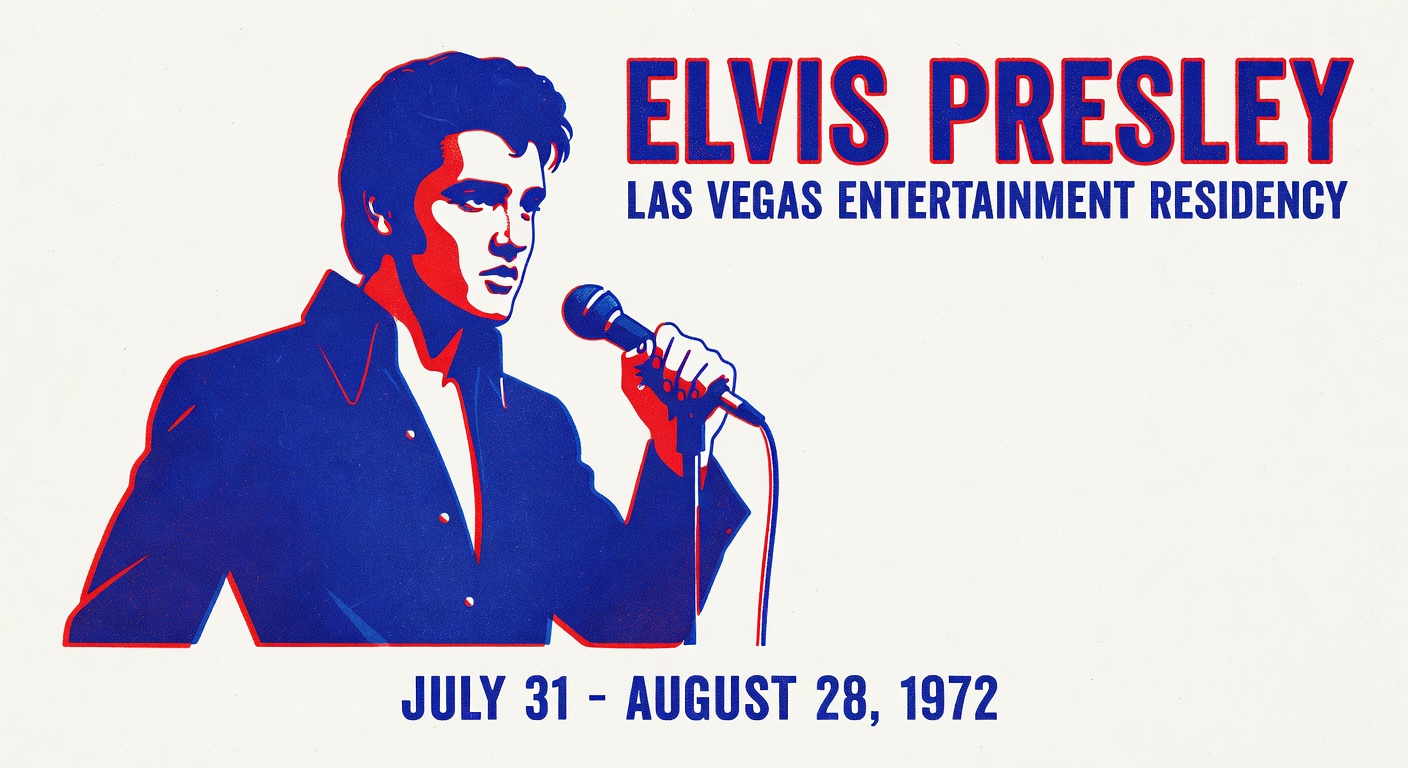
Elvis opened at the International Hotel (now called the Westgate) on July 31, 1969. He performed 636 shows over seven years. This is a case study in how a single entertainer can reshape the economics of a casino and create security problems that had never existed before.
The International was new in 1969, built by a consortium that needed a marquee to draw high-end clientele. Elvis was the marquee. His four-week engagement was booked to break even at the box office (tickets sold for 15-20 dollars, much of it going to the casino floor). The real profit was supposed to come from his presence drawing gamblers.
It worked beyond projection. The casino saw a 400% increase in midweek table play and a 300% increase in slots during Elvis weeks. The economic model proved out. But it created security nightmare because celebrity attracts two categories: fans who want to see the star, and criminals who see the star as a distraction.
The Crowd Management Problem
The International was not built for the crowds Elvis generated. On opening night, over 2,000 people showed up to the theater. The casino could fit 2,000. The overflow crashed the lobbies, the parking, the elevators. By the second week, we had to implement restricted entry and credential management. This was not standard practice in Vegas in 1969. Casinos did not do crowd control; they welcomed every body.
Elvis changed that. His presence made the casino a destination rather than a gambling facility. People came to see him and left tickets unsold for gamblers. We had to implement a system where fan access was separate from gambler access. This was the first time a Vegas casino had truly separated customer types.
We also had to develop what I would call "perimeter control." Elvis's dressing room, his private elevator, his parking space all had to be secured from the public. This required hiring additional security, training them on restricted-access protocols, and building new infrastructure (private hallways, service entrances, vehicle screening). The cost was enormous.
The Criminal Opportunity Window
Elvis was a target for multiple categories of crime. Theft (fans wanted to steal memorabilia, objects he had touched). Fraud (counterfeit tickets were being sold in the parking lot within days of his opening). Organized crime (they saw his presence as an opportunity to exploit the chaos and move contraband). Assault (uninvited guests who wanted to meet him or thought they had legitimate access).
The most serious was the counterfeit ticket operation. By week two, organized crime groups were selling fake Elvis tickets in the parking lot and on the street. These were sophisticated forgeries. We worked with local law enforcement and discovered the operation was moving thousands of fake tickets per week. We had to implement a credential system with holograms and security features that are standard today but were novel then.
The counterfeit operation was costing the casino 20,000 to 30,000 dollars per week (in 1969 dollars). This sounds small in absolute terms, but multiplied across 52 weeks of shows, it was substantial. We shut it down by coordinating with federal agencies and implementing venue security that basically no casino had implemented before.
The Personnel Problem
Elvis traveled with a large entourage (15-30 people depending on the week). Each member of the entourage had access to restricted areas. Each was a potential security vulnerability. We had to implement background checks and ongoing monitoring for members of his party. This was not done for performers in Vegas before. It is standard now, but in 1969, it was considered intrusive.
We discovered that members of his entourage were bringing narcotics into the casino. Not for sale (as far as we knew), but for personal use. We had to implement drug testing and compliance protocols with Elvis's manager to enforce rules. This is delicate because the star is also your draw and you cannot afford to lose them through conflict. We walked a line between security and accommodation.
The real issue came in 1972 when security discovered that one member of Elvis's party was using his access to run a card-counting team out of the blackjack pits. We shut it down quietly (not worth the publicity), but it revealed that our access controls were not sufficient to prevent insider gaming exploitation.
The Departure and Legacy
Elvis stopped performing in Vegas in 1976, though he performed there sporadically afterward. The casino's financial performance dropped 30% the first month he did not perform. The experiment had worked so well that the casino kept his suites available and offered them to other top performers at discounted rates, hoping to recreate the Elvis effect.
No performer replicated it. Elvis was singular. But his seven-year residency forced Vegas casinos to professionalize security, implement access controls, manage crowds, and deal with organized crime at a scale they had not before. The security infrastructure that is standard in Vegas today was largely built to accommodate Elvis.
The historical record mostly talks about Elvis's music and his performances. The security side is less documented. But his presence reshaped how casinos think about celebrity, control, and the potential for criminal exploitation of crowd chaos. From a security perspective, Elvis was the inflection point where Vegas casinos had to become sophisticated about access control and threat assessment.