Live poker runs on etiquette. Etiquette is a protocol, not a mood.
That is the main thing to understand before worrying about which rule applies when. A live poker table is a small, fast, rule-bound system attempting to process roughly 25 to 35 hands per hour across 6 to 9 players, with real money, imperfect information, and cameras overhead. Etiquette exists to prevent the system from stalling, leaking information, or producing disputes. Every convention can be traced back to one of those three purposes.
With that in mind, here are fifteen rules, organized loosely by the kind of failure they prevent.
Rules about not leaking information
First, and most important, act in turn. Acting out of turn gives downstream players information they have not paid for, specifically knowledge that you plan to fold, check, or raise. In a competitive game this is worth money. The penalty at most cardrooms is that your action binds, meaning you must perform it if the preceding action supports it. Do not rely on the floor to bail you out.
Second, do not discuss the hand while it is live. Even if you have folded, even if you are just narrating to a friend, even if your comment seems neutral. The rule is called "one player to a hand" and it is absolute. You may talk about the weather. You may not say "oh wow" when the turn comes.
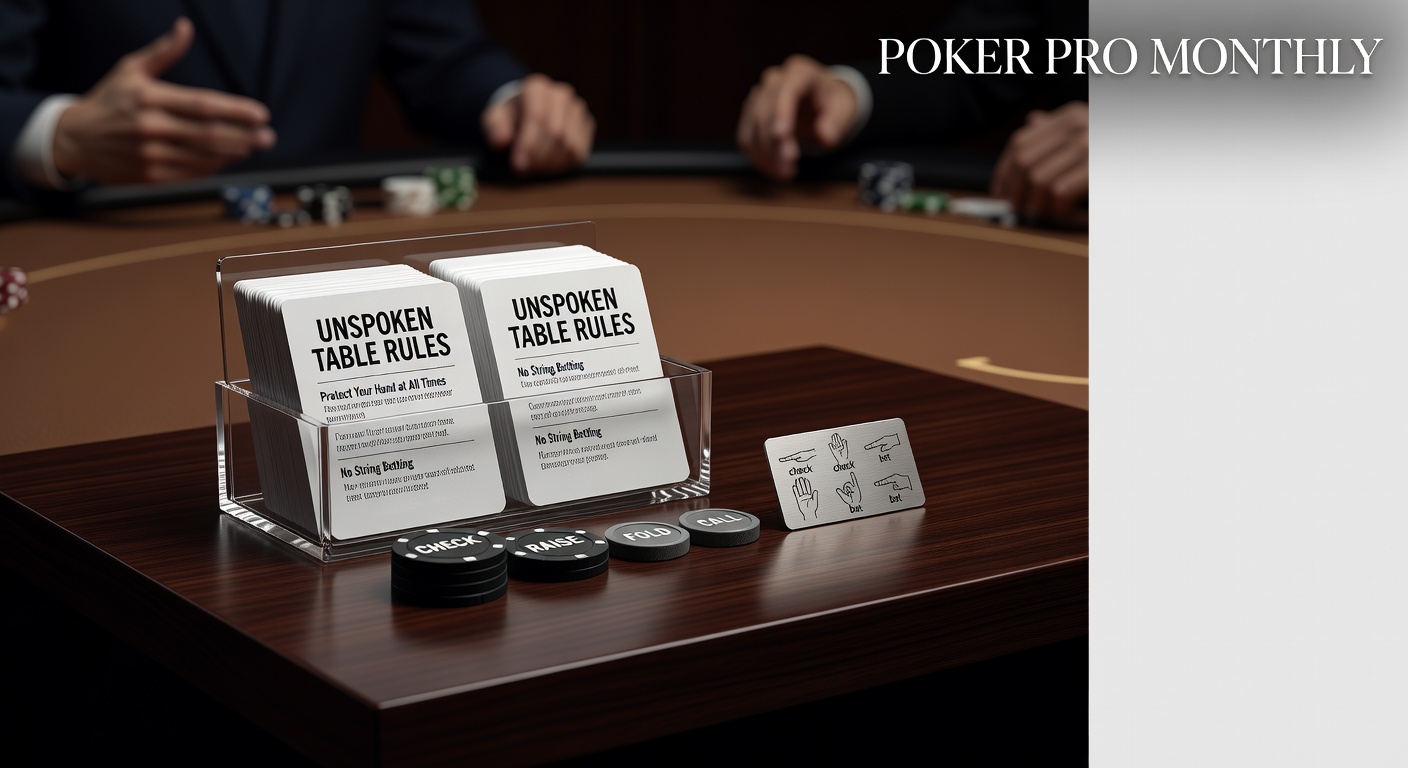
Third, protect your cards. Use a card cap, a chip, or your hand. A dealer who accidentally mucks your hand because it drifted too close to the discard pile cannot rule in your favour. Your cards, your responsibility.
Fourth, do not show your hand unless required. Showing one player what you folded, even at a casual table, gives that player information and removes it from everyone else. This is called "show one, show all" at regulated rooms and the dealer will turn your hand over if you violate it.
Rules about not stalling the game
Fifth, know your action before it is your turn. A player who waits for the dealer to prompt them, then takes thirty seconds to count chips they could have counted two minutes ago, costs the whole table money per hour. This is the most common etiquette failure among new players, and the easiest to fix.
Sixth, make a single motion for your bet. Reaching into a stack, pulling out chips, pausing, adding a chip, pausing, removing one, then pushing the pile forward is called a "string bet" and it is disallowed because it lets you gauge reactions mid-action. Decide. Push. Done.
Seventh, use verbal declarations when it is faster. "Raise to 80" locks your action. The chips follow. Verbal trumps physical if there is a dispute.
Rules about not producing disputes
Eighth, always put your largest denomination chips on top of your bet stack when pushing chips forward. The dealer confirms the size at a glance. Hiding a black chip under a stack of greens, intentionally or not, is called "hiding your hand" and can result in the chip being ruled out of the bet.
Ninth, keep your stack visible and roughly organized. Other players have a right to estimate your stack size. Rainbow towers of 400 chips spread behind a drink are not a valid hiding strategy and most rooms will ask you to rebuild.
Tenth, do not splash the pot. Place your bet in a tidy stack in front of you. The dealer pulls it in. Throwing chips into the existing pot makes the bet uncountable, which is the dealer's problem, which quickly becomes your problem.
Eleventh, muck cleanly when you fold. Forward motion, toward the dealer, face down. Tossing cards sideways, or even worse, revealing them as you muck, breaks rule four above and can earn you a warning.
Rules about the table's social contract
Twelfth, tip the dealer when you win a significant pot. This is customary in most North American rooms and less so in Europe, but the principle is the same: dealers are paid largely from tokes. A dollar on a decent pot, more on a large one, is within norms. Not tipping is not a crime; it is simply a signal.
Thirteenth, do not berate the player who beat you. The jargon term is "tap the glass." A player who calls an ill-advised river and gets there is a player you want to keep at your table. Scolding them is, among other things, a strategic error.
Fourteenth, phones at the table are tolerated but not encouraged. Never phone while in the hand. Many rooms disallow it entirely; all rooms disallow it if a hand is still in progress. The live-game assumption is that you are engaged in the action.
Fifteenth, the interesting part is this. The entire system of live poker etiquette rewards predictability. A predictable opponent is easier to read, which disadvantages them strategically, but predictability in procedure (acting in turn, betting cleanly, handling chips visibly) is what makes the game run. The game can tolerate unusual players. It cannot tolerate unreliable procedures.
One final structural observation
The rules above are not a social test, and following them does not make a player good. They make a player legible, which is a precondition for the table to function. A new player who follows all fifteen rules will still lose money if their strategy is weak. But they will lose money without causing friction, without drawing the floor, and without contaminating other players' hands, which is the minimum bar for being welcome in any regulated poker room.