Live poker has formal rules and unspoken rules. The formal ones are in the rulebook. The unspoken ones matter more because violation gets you banned faster than cheating sometimes.
I'm going to go through these systematically because I think about games as closed systems, and poker etiquette is a subset of that system. It's not moral. It's mechanical. Break it, the game's social structure collapses.
Positioning and Timing
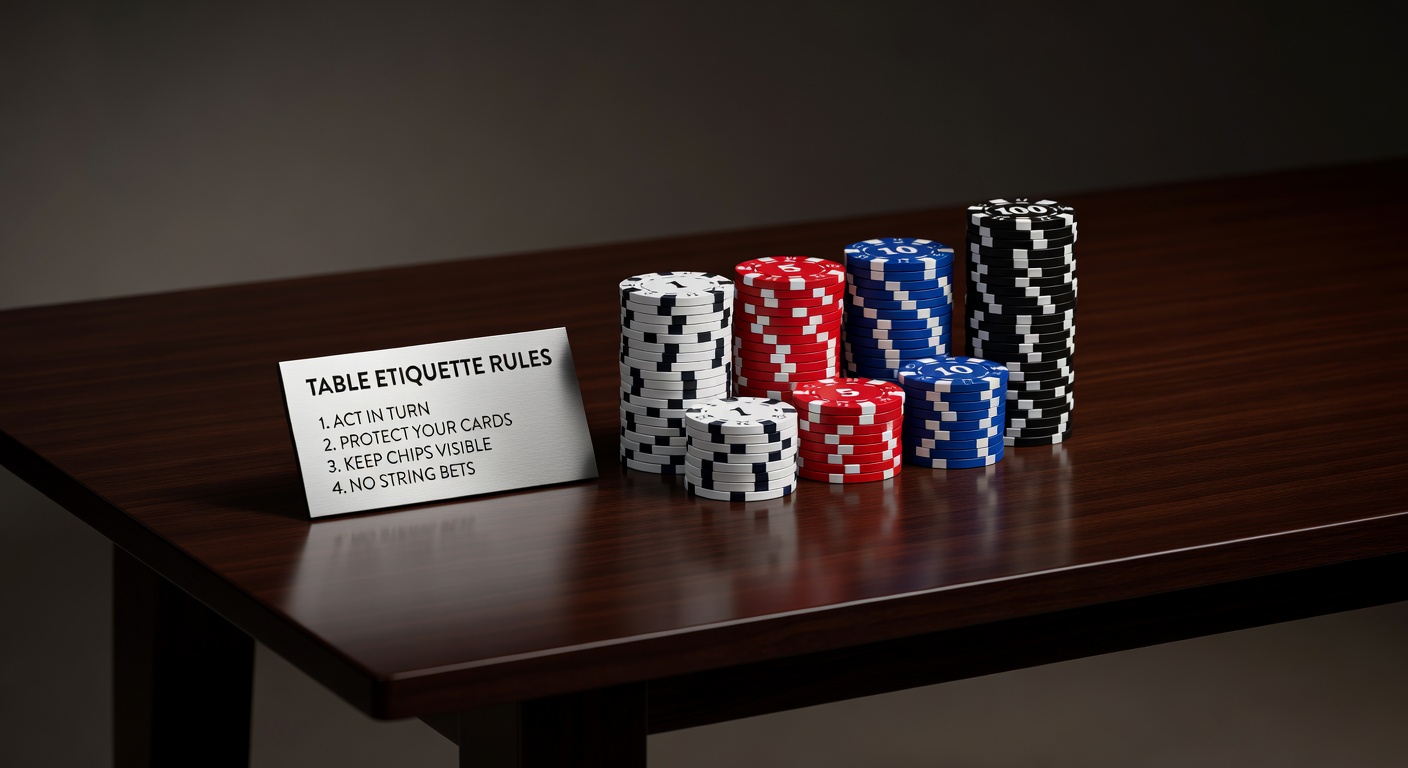
First: act in turn. Don't fold out of turn. Don't bet out of turn. Don't reveal your hand before action completes. Sounds obvious. Happens constantly with new players. The reason: it changes information flow. If you fold early, you've revealed information that affects how others play. If you check out of turn, you've given others a false signal. Act when it's actually your turn.
Second: don't string bet. If you want to bet, say the amount once. "Two hundred." Then put the chips out. Don't say "I call your hundred" then add chips. That's "string betting" and dealers will stop you. It's a protection against "I meant to call but actually I'm raising" manipulation.
Third: don't splash the pot. Put your bet in front of your seat. Not into the pile of chips already in the middle. If you splash, the dealer has to recount. It slows the game. It's disrespectful to the dealer.
Information Management
Fourth: never angle-shoot. An angle-shoot is a technically legal move that violates the spirit of the game. Example: bet, your opponent reaches for chips to call, then you say "I'm actually folding." Technically you can do this if action isn't complete, but it's manipulation. Don't do it.
Fifth: don't reveal your hand to anyone except the dealer until the hand is complete. If you fold and show another player your cards, you've given them information they didn't earn. That player now has an unfair advantage against players who didn't see the cards.
Sixth: mucked cards stay mucked. If you fold and your hand goes into the muck, it's dead. You don't get it back. Don't ask. Don't touch the muck. It's mixed cards now.
Conversation and Attention
Seventh: don't talk about the hand in progress. Example: you've folded. Two players are still in. Don't say "wow, if the river pairs the board, this guy wins." You're influencing outcomes by speaking probabilities aloud. Silent is golden.
Eighth: pay attention. Your turn comes. You take five minutes to decide. That's slow. Poker's supposed to move. Think before it's your turn. When action reaches you, you should know your decision in 20 seconds.
Ninth: don't go to the bathroom when you're supposed to be in a hand. If you're about to be in a hand, stay seated. If you need to use the bathroom, do it between hands.
Tenth: don't criticize other players' play mid-game. Wait until after. If someone plays badly and you feel the need to explain why, do it at the break, not at the table. It creates tension and slows the game.
Chip and Betting Protocol
Eleventh: count your chips before you sit. If you sit with 500 and claim you had 700, that's your problem. Chips are counted on seating.
Twelfth: don't touch chips that aren't yours. Your chips are in front of you. Other players' chips are off-limits. If you move someone else's chips, it's a rules violation.
Thirteenth: be clear with your bets. Announce amounts. If you're betting 300, say "three hundred." Don't mumble or count it out slowly like you're trying to negotiate. Clarity prevents disputes.
Social Protocol
Fourteenth: tip the dealer. Casinos don't pay dealers well. They make tips. Win a hand, give the dealer a chip. It's not mandatory, but it's expected. About 5 percent of a winning pot is standard.
Fifteenth: don't swear at the dealer. They didn't deal you bad cards. They didn't give you variance. They dealt the hand correctly. Swearing at them is unprofessional and gets you removed.
Why These Matter
The interesting part is this: poker etiquette isn't moral. It's functional. Each rule exists because violating it creates a specific problem:
- String betting creates ambiguity about intention
- Talking out of hand creates false signals
- Splashing the pot creates recount friction
- Slow play creates time waste
- Angle-shooting creates unfair advantage
These aren't rules about being nice. They're engineering constraints on a game system.
If you violate one accidentally, you'll be corrected by the dealer. If you violate deliberately, you'll be warned. If you violate repeatedly, you'll be asked to leave.
New players often think poker is just about cards and math. The cards and math are half. The other half is understanding that poker's a social system with technical requirements. Learn the system. The strategy will follow.