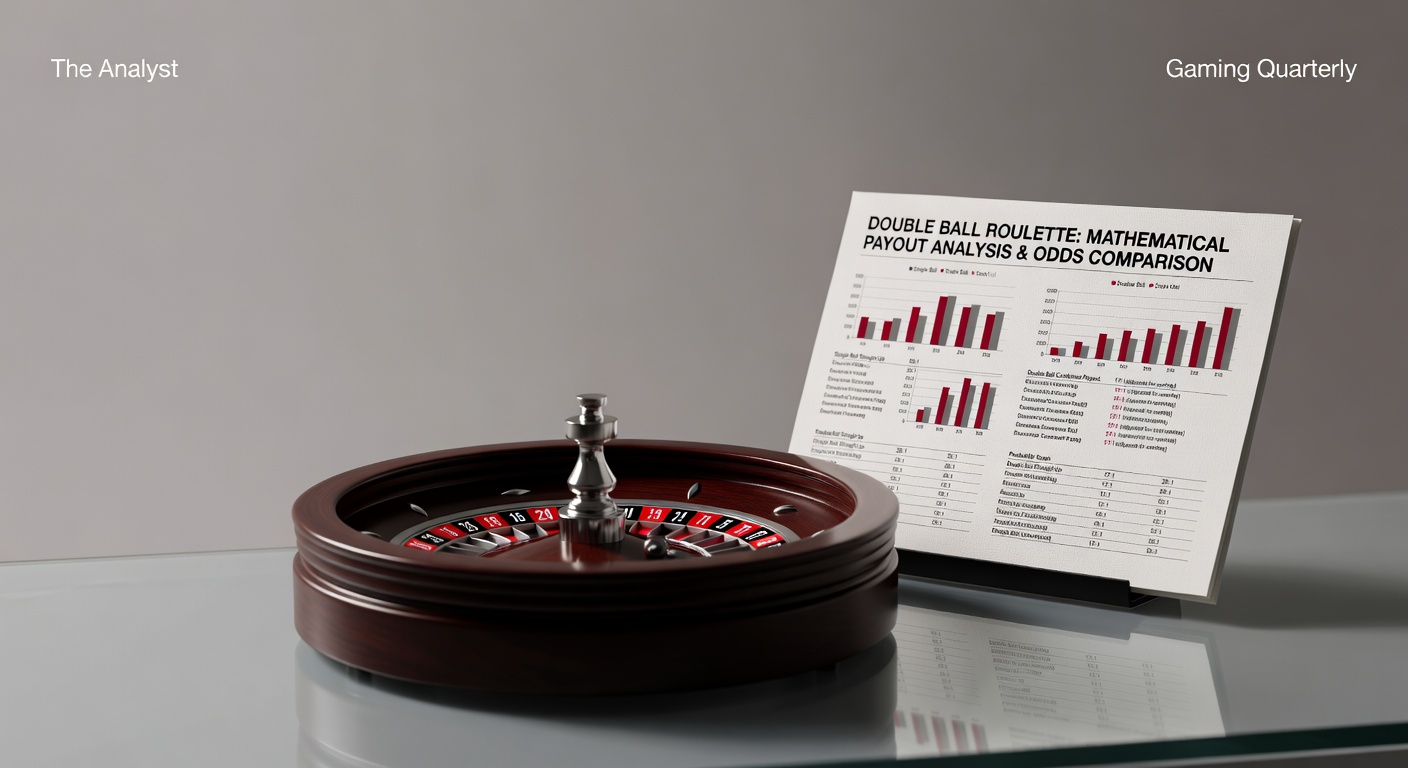
Double Ball Roulette is an Evolution Gaming variant that uses two balls instead of one. The wheel's the same. The payout structure changes. That's where it gets interesting.
I'm going to explain the mechanism because most players don't understand how two balls interact with a single roulette wheel, and casinos don't exactly advertise the math.
The Mechanics
Standard roulette: one wheel, 37 pockets (European) or 38 (American), one ball. Ball lands in one pocket. You're paid based on what you bet.
Double Ball Roulette: same wheel, two balls. Both balls are released together. Both land independently. You can win on both, one, or neither.
How does this work mechanically? The wheel spins. Two balls are released from different points on the wheel's circumference, rotating in opposite directions. They land in different pockets because they start from different positions and rotate in opposite directions. Collision is technically possible but extremely rare. Evolution's tested this. Over millions of spins, collision rates are negligible.
Odds of both balls landing in the same pocket: roughly 1 in 37 (same as normal roulette odds, actually). It happens but rarely.
The Payout Structure
Here's where the math gets them money.
If you bet on a number, you can win:
- Both balls on your number: 1000 to 1 payout
- One ball on your number: 17 to 1 payout
- Neither: you lose
Sounds generous. Let me show you the RTP (return-to-player).
Single-number bet on European roulette: 35 to 1 payout on a 37-to-1 shot. RTP of 97.3 percent.
Double Ball Roulette, single number: probability of hitting one ball is 1/37, probability of hitting both is (1/37)^2. The expected payout depends on your stake. Let's say you bet 100.
Expected value: (1/37 * 117) + ((1/37)^2 * 1000) + (rest is 0) = roughly 3.16 + 0.73 = 3.89 per 100 wagered. That's an RTP of 96.1 percent. Slightly worse than standard roulette.
But for even-money bets (red/black), the structure changes. You can hit with one ball, both balls, or neither. The payout for one ball is 1 to 1 (same as normal roulette). The payout for both balls is higher. This makes even-money bets slightly worse RTP too.
The Psychological Hook
Two balls means two chances to win. That feels better. It creates the illusion of higher probability. But the payouts are adjusted down so the RTP is lower.
This is a classic casino design move. Increase the frequency of near-wins and small wins. Decrease the frequency of big wins and increase the RTP slightly to account for the psychological boost.
Two balls missing your number feels unlucky twice, which creates engagement ("I was so close"). One ball missing feels like just bad luck once. Casinos are selling engagement, not probability.
Strategy Consideration
There is no strategy that beats the math. The RTP is what it is. You can bet red or black or numbers. The house edge doesn't change.
Some players try to exploit the two-ball structure by betting on adjacent numbers, thinking two balls are more likely to hit one of them. They are. But the payout's also lower for those bets. The math is adjusted.
Don't fall for edge cases. There aren't any.
Why Casinos Offer It
Double Ball Roulette exists because it's different. Player variance increases (you win more often but at lower amounts). This creates longer sessions. Longer sessions mean more action, more variance, more entertainment.
For the operator, RTP is slightly lower (96.1 percent vs 97.3 percent). Over millions of spins, that's a material difference.
For the player, it's a different game with slightly worse odds. The payoff is slightly higher engagement.