What is baccarat in its essence? It is a game without decisions. You place a bet on banker, player, or tie, and the cards resolve the outcome. The only choice is how much to risk. One might ask: what kind of game leaves the player only the choice of risk, not the choice of play?
Baccarat arose in the courts of Northern Italy in the 1400s, likely derived from an older game called Tarocchi. The name itself points to chance: "baccarat" may come from the Italian word for zero, "baccara." The earliest written record appears in a manuscript describing games played by Italian nobility. The game was simple then and remains simple now: two hands (banker and player), with the hand closest to nine winning. Face cards and tens count as zero. Other cards count as face value.
The game traveled to France in the reign of King Charles VIII (1470s), where the nobility became obsessed with it. By the 1500s, baccarat was being played in salons across France and Italy. The question this raises for the philosopher is: why did a game of pure chance attract nobility more than games of skill? One answer is that games of pure chance allow wealth to speak directly, without the mediation of knowledge or talent.
Baccarat and the Display of Wealth
A merchant learning chess might beat a nobleman through skill. A merchant playing baccarat against a nobleman plays on equal terms. The nobleman's advantage, if any, is only money. This makes baccarat a game of social display. By playing baccarat, you announce: I have money to bet, and I am comfortable losing it based on chance alone.
Skill games like poker or chess require study and practice. They reward effort. Baccarat rewards only capital and fortune. For a ruling class, this is attractive. It creates a space where inherited wealth, not earned knowledge, determines outcomes. Or appears to. (The mathematics are the same for rich and poor; chance has no class. But the display of money through betting creates the illusion of class advantage.)
Baccarat remained a game of nobility and merchant classes through the 1600s and 1700s. Common people played in back rooms, but the famous baccarat games were in court circles and palatial estates. The stakes grew. By the 1800s, baccarat salons in London and Monte Carlo attracted players betting thousands of pounds per hand.
The Social Question
One might ask: does a game of pure chance reveal something true about human nature, or does it create an illusion that we mistake for truth? Baccarat produces streaks. Six consecutive banker wins. Five consecutive player wins. These feel significant. But they are what probability predicts. A fair coin flipped ten times will produce runs of five heads or tails roughly 25% of the time.
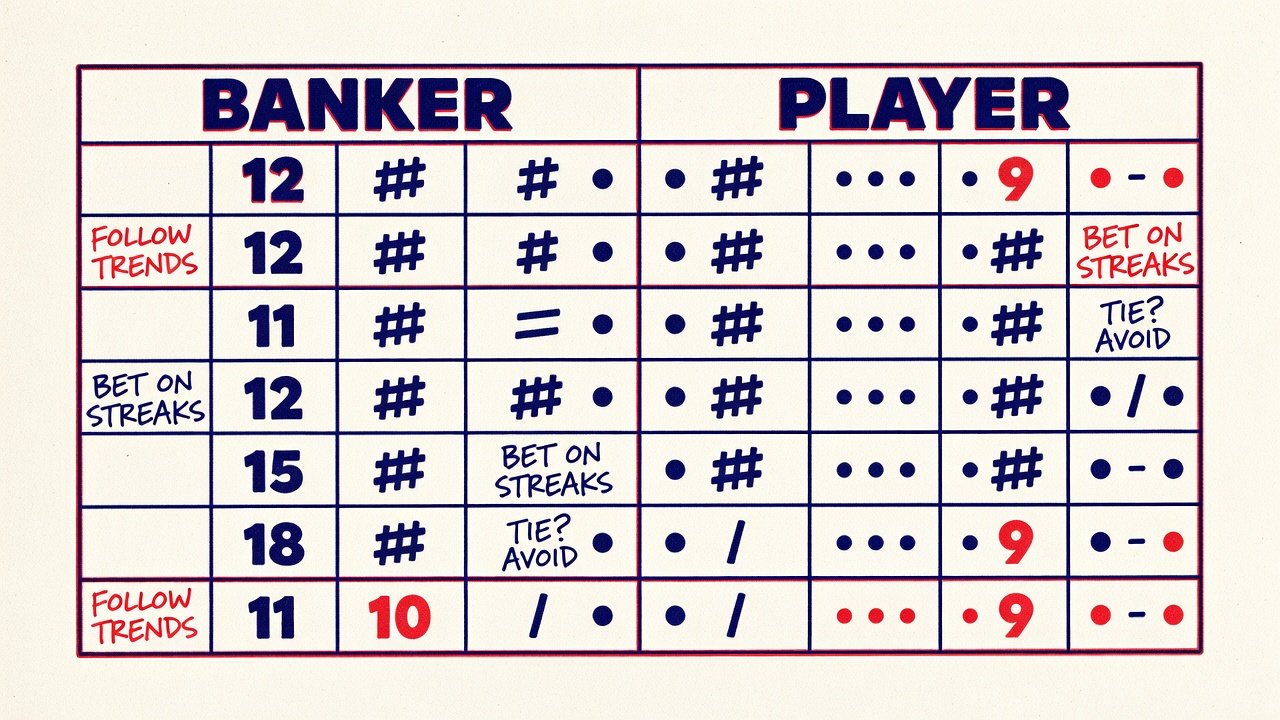
Yet we are compelled by streaks. We believe they mean something. This is the gambler's insight: we do not trust chance; we interpret it as pattern. We see a banker streak and believe the banker is "hot" rather than accepting that randomness often looks like patterns. Baccarat accommodates this compulsion. It is structured to show you patterns, even if those patterns are illusions.
The player who says "I noticed the banker won four times in a row, so I bet heavy on the player," is the player who mistakes pattern for prediction. Baccarat has no memory. Each hand is independent. The banker's history is irrelevant to the next card dealt. But the structure of baccarat (watching the reels, the squeeze, the dealer announcing winners) makes streaks feel significant.
From Salons to Singapore to Macau
Baccarat remained a game of high-stakes casinos through the 1900s. The post-World War II period saw baccarat expand into Asia. High-stakes baccarat rooms opened in Singapore, Hong Kong, and eventually Macau. These rooms catered to wealthy businessmen and crime figures (the distinction is not always clear).
Macau became the center of baccarat gambling by 2000. The Venetian Macau, opened in 2007, dedicated more table space to baccarat than to any other game. This was strategic: baccarat attracted the "whales," high-rollers betting 100,000 to 1,000,000 Naira per hand. The casino's expected return from baccarat is lower than from other games (house edge is 1.06%), but the volume is so high that whales playing baccarat generate more profit than casual players playing slots.
The cultural shift is interesting. Baccarat remained a game for the wealthy even as access democratized. Online baccarat on Stake or Bet9ja brought the game to anyone with an internet connection and 50 Naira. The whale playing in Macau and the student playing on their phone in Lagos are playing the same game with identical rules and identical house edge. What changed is access, not the nature of the game.
The Philosophical Question
Baccarat is the simplest game because it removes skill entirely. You cannot make a mistake in baccarat except betting wrong or betting more than you can afford. The game is purely about risk tolerance and luck. This raises a question: what does baccarat reveal about us? Does it show that we want to test our luck, or that we want to test our nerve (how much we are willing to risk)?
If you play baccarat, what are you trying to discover? That you can win? Winning at baccarat is chance, not discovery. That you can handle loss? This baccarat will teach, perhaps painfully. That you understand probability? Baccarat reveals mostly that you do not. The game strips away strategy and leaves only the raw question: how much are you willing to stake on a flip of chance?
This is why baccarat attracts the wealthy and the desperate in equal measure. The wealthy have money to stake and the luxury of time. The desperate have hope and desperation. Baccarat treats both the same: both win or lose based on cards they cannot control. In a strange way, baccarat is democracy. It cares nothing for station, only for stakes and chance.