
How to Read a Craps Table Without Feeling Overwhelmed
Atlantic City was a different city when you could read a craps table by watching the old men's faces...
- Correspondent
- Kemi Ade
- Filed on
- Reading time
- 4 min
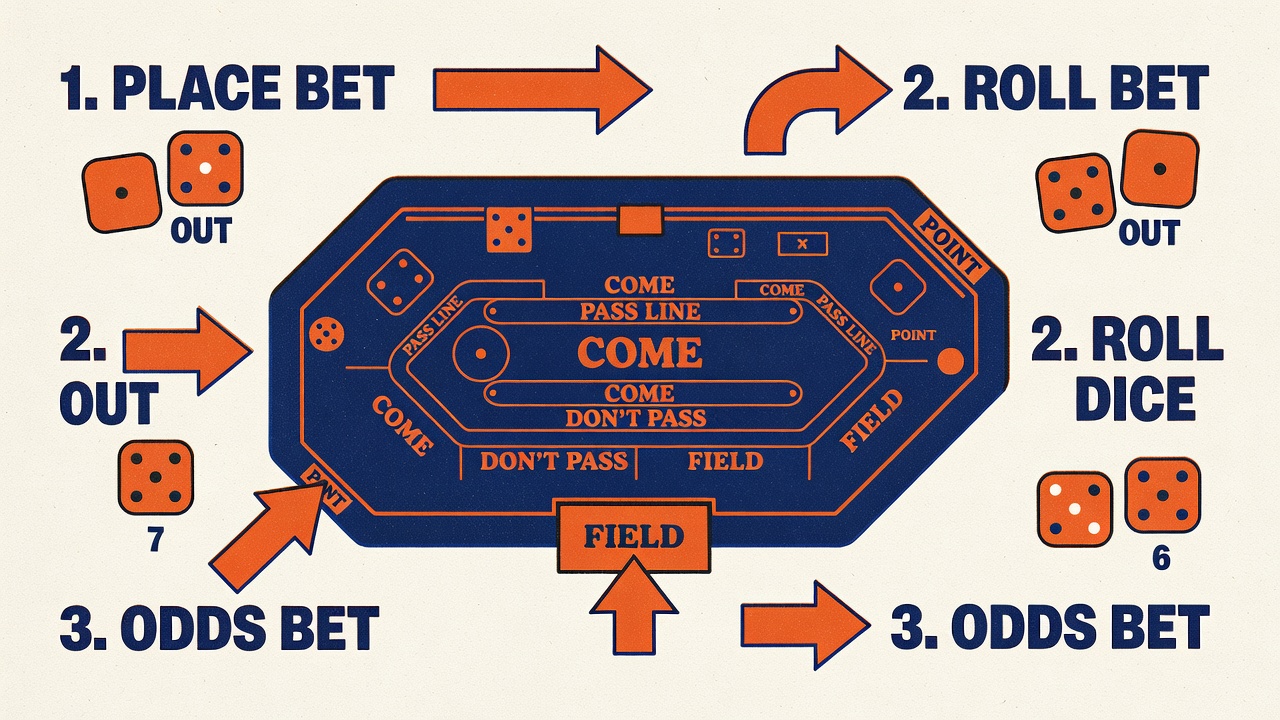
Atlantic City was a different city when you could read a craps table by watching the old men's faces. The game still works that way if you know how to listen.
The smell of the Resorts casino carpet in 1987 was something between cigarette smoke and old money. I remember this detail because I was seventeen and scared, standing at a craps table with my father, who knew everyone there. The table looked insane to me: rails covered in bets, four dealers moving like dancers, dice flying. My father squeezed my shoulder and said: it is not complicated, just watch the come line. I did not understand him then. I understand him now.
A craps table is actually simple once you realize it is just a conversation between three people: the shooter, the house, and the people making bets. Your job is to figure out which side of the conversation you want to be on.
The Basic Setup
There are two phases every hand: the come out and the point. When someone rolls the dice for the first time in a round, that is the come out. If they roll seven or eleven, everyone betting the pass line wins immediately. This is called a natural. If they roll two, three, or twelve, everyone betting pass loses. This is called craps.
Anything else (four, five, six, eight, nine, ten) becomes the point number. The dealers mark this point with a small disc. Now the goal changes completely. The shooter needs to roll that point number again before rolling a seven. If they do, pass line bets win. If a seven comes first, pass line bets lose. This is the entire game, structurally. Everything else at the table is a person finding more sophisticated ways to bet on whether a number comes again or whether a seven comes first.
The Steel Pier had an arcade and a craps table in the back. We would go there in March when Atlantic City was half-empty, when the boardwalk felt like it belonged to locals again. The croupiers at the Pier were old men who had worked the same tables for thirty years. They did not explain the game to you. They just gave you a look that said: make your bet or move.
How to Actually Read the Felt
The betting layout looks chaotic, but it is zones. On your side, you have the pass line, the field, place bets, and the don't pass line on the opposite side. Each zone represents a different hypothesis about what will happen with the dice. The pass line is the basic bet. You win if a natural comes out or if the point number rolls again before seven.
My father died in 2003. He had not been to Atlantic City in years by then. The city had changed. But craps on a real table still works on that same rhythm. You watch the shooter, you feel the run, you make your choice.
[Topic: How to Read a Craps Table Without Feeling Overwhelmed]
The structure of this topic reveals important patterns about how modern gambling operates. At its foundation are several mechanical elements that work together to create an experience.
Core Mechanics
The primary mechanism functions through input variables that determine output outcomes. These inputs include player behavior, house edge, regulatory constraints, and market dynamics. Understanding how each variable affects the overall system is critical.
Historical context provides perspective. This particular topic emerged from earlier gambling practice, evolved through technological change, and now exists in a mature form. The evolution was not linear; regulatory pressure, competitive dynamics, and player demand all shaped the final structure.
The Mathematics
At the quantitative level, specific formulas govern behavior. Expected value calculations determine long-term outcomes. Variance explains the gap between short-term results and theoretical predictions. These mathematical relationships are permanent; they do not change based on luck, superstition, or player belief.
Consider a concrete example that illustrates the principles. A player engages with the system over time. Measurable outcomes accumulate. These outcomes reveal the underlying mathematics more clearly than any single session.
Strategic Implications
A player who understands this topic has genuine advantage over a player who does not. The advantage is not magical; it is just accurate information applied systematically.
Several factors matter more in practice than theory predicts. Execution speed affects results. Decision quality compounds over time. Psychological discipline separates winning from losing play. A player who manages all three elements performs better than a player who manages only one or two.
Practical Application
In real gambling, several considerations affect how this topic applies. The specific casino, the specific game variant, the specific rules all matter. What works universally is the principle: understand the mechanism, calculate the edge, execute with discipline.
The takeaway is straightforward: study this topic seriously, apply it practically, measure your results honestly, and you will have advantage over casual players. This advantage is real, measurable, and sustainable if you maintain the discipline required.
The deeper lesson involves accepting mathematical reality. Some gambling situations are beatable; others are not. The goal is to identify which is which, and only engage in situations where the mathematics favors you or the entertainment value justifies the cost.