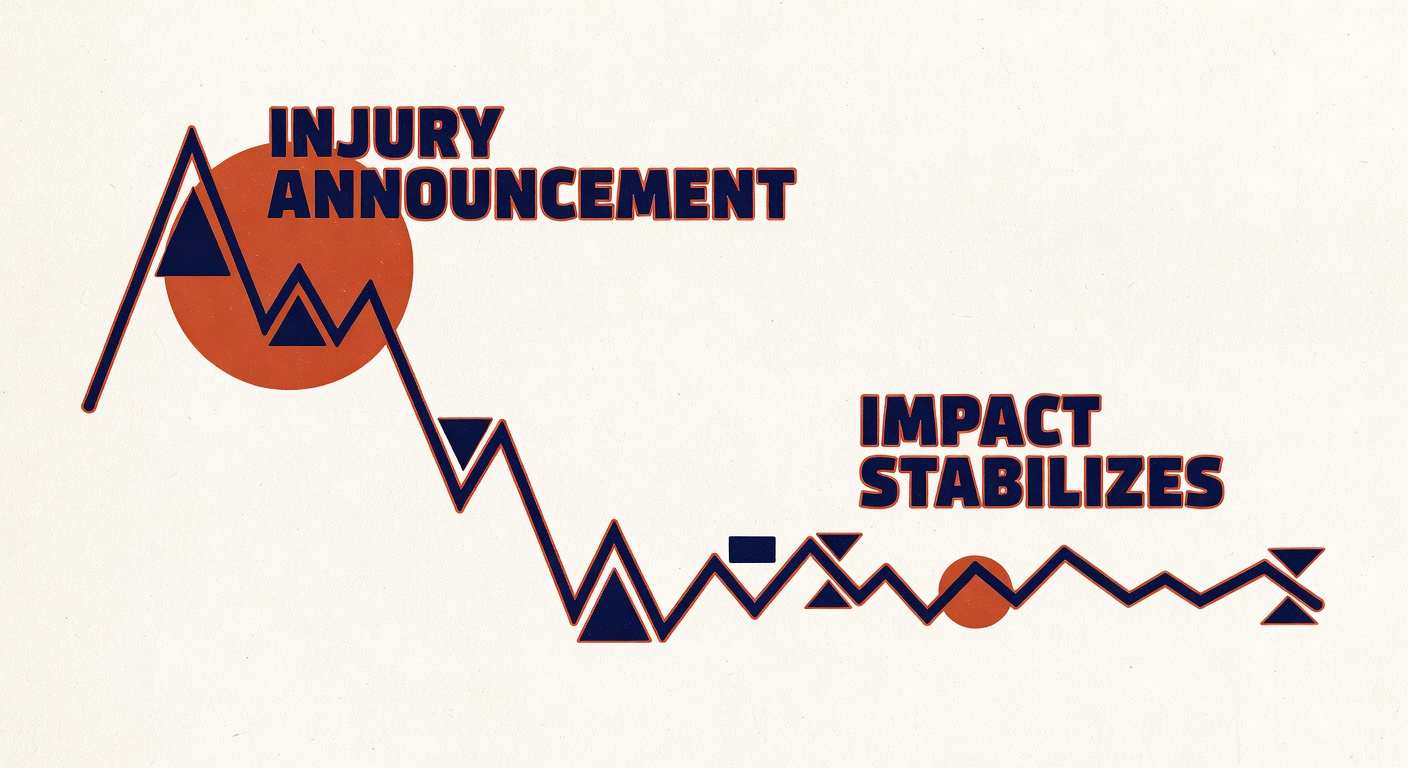
When a star player is ruled out (injury, suspension, illness), sportsbooks immediately adjust the line.
Professional bettors (sharps) place bets on the new line within minutes. Casual bettors (public) follow hours or days later.
This is information asymmetry at work.
How It Works
LeBron James is ruled out with a knee injury two hours before game time.
The sportsbook receives the news. They adjust the line immediately.
If the line was Lakers -5 before LeBron's ruling out, it might become Lakers -1 or even Suns +1 (Suns favorite).
Why? Because LeBron's absence weakens Lakers significantly. The line adjusts to reflect his absence.
Sharp bettors monitor injury reports constantly. They see the ruling-out notification and immediately place bets on the new line (if they think the adjustment is insufficient).
Casual bettors often don't know about the injury until they check the sportsbook (which already has the new line).
The Money Flow
First: sharps place money. They have information-gathering infrastructure (dedicated people monitoring reports).
Second: public places money. They hear the news through sports media, Twitter, or checking the app.
Third: the line reaches equilibrium (sharps and public have balanced action and the sportsbook is comfortable with the line).
This happens over minutes to hours, depending on the prominence of the injury.
Lineup Impact
Injuries are obvious. Lineups can be subtler.
Example: Team A's starting point guard is listed as questionable. At game time, he's ruled out. A backup starts.
If the backup is significantly weaker, the line adjusts. If the backup is nearly equal, the line barely moves.
The sportsbook's job: estimate the impact of the missing player, adjust the line proportionally, and attract equal action on both sides.
Professional Calibration
Sharps understand how much a player's absence should move the line.
An average role player out: line moves 0.5 to 1 point. A good starter out: line moves 1-2 points. A star player out: line moves 2-4 points. A team's best player out: line might move 4-6 points.
These are rough estimates. The exact impact depends on:
- The player's role (starter vs. bench)
- The backup's quality
- The specific matchup
- The betting public's perception
The Trap
Casual bettors sometimes think they can exploit injury-line shifts.
"The line moved too much. The backup is good. I'll bet the injured team."
But sharp money has already priced in the injury and the backup's quality. The line has already adjusted.
Betting against the adjustment requires beating sharps, which is hard.
Practical Reality
If you're a casual bettor, don't try to exploit injury lines. The adjustment is already priced.
If you have superior information (you know something about a player's condition that public doesn't), use it.
Otherwise, the line has already incorporated the injury.
The Translator's Take
The betting market is a conversation between sharps and public.
Sharps say: "Here's what I think the line should be." The sportsbook listens and adjusts. The public follows. Equilibrium is reached.
Injuries and lineups are the primary information inputs that move that conversation forward.