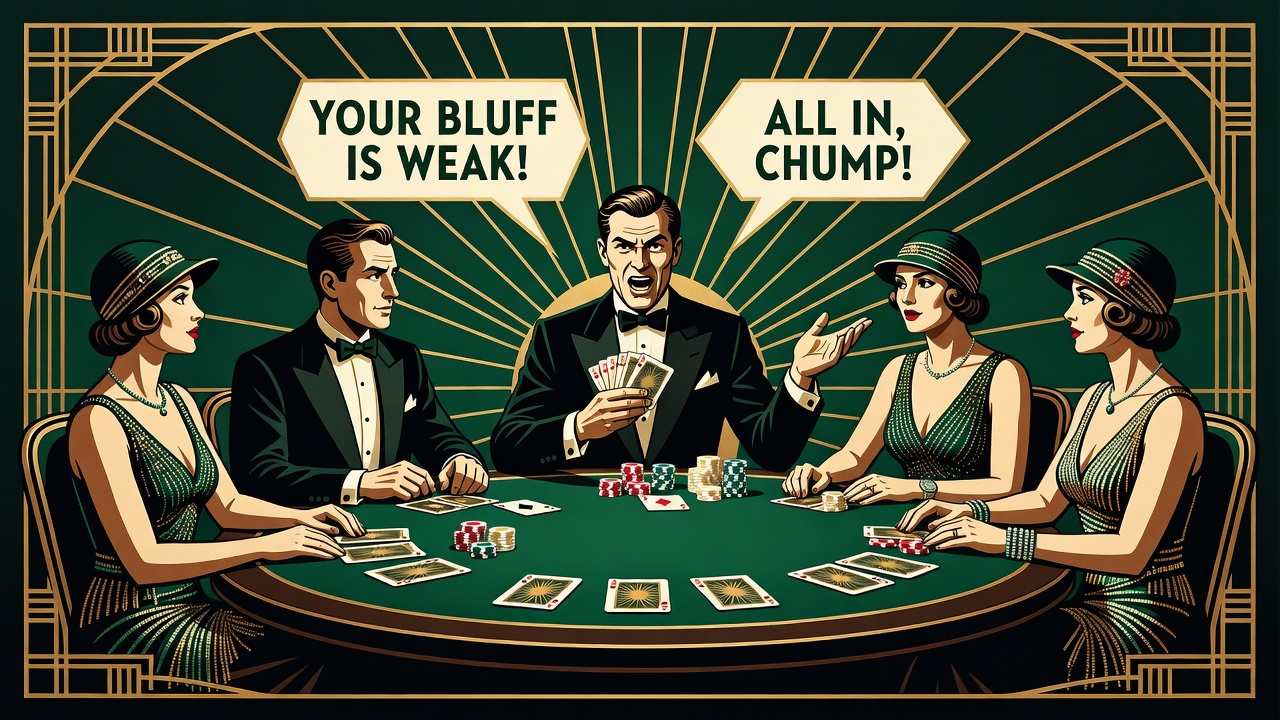
Texas Hold'em emerged from Texas in the 1930s, though historical documentation is sparse. The earliest reliable accounts place it in Dallas during the 1930s and 1940s, played in small games among oil workers and ranch hands.
The game remained regional for decades. Other poker variants dominated: Five-Card Draw was the American standard, Seven-Card Stud was popular in East Coast casinos, Razz had devoted followers in niche circles.
The Las Vegas Moment (1963)
In 1963, a casino operator named Blondie Forbes brought Texas Hold'em to Las Vegas. She convinced the Golden Nugget to add a Texas Hold'em table. It was not immediately popular. Most Las Vegas players knew Stud. Hold'em seemed odd to them: only two cards in hand, five community cards. Counterintuitive.
But a player named Doyle Brunson played it. Brunson had the reputation. Other players started showing up.
By 1969, Binion's Horseshoe Casino added Texas Hold'em games. Benny Binion, the casino's owner, recognized that Hold'em had potential. The game had action: more hands per hour because players could fold early. More action meant more house revenue from rake.
The Tournament Invention (1970)
In 1970, Binion created the World Series of Poker (WSOP). The inaugural event was Texas Hold'em exclusively. A tournament, not a cash game. This was novel. Poker tournaments were uncommon.
The WSOP legitimized Hold'em. It became "the" poker game. Players traveled to Las Vegas to compete. Winners were crowned. Prestige attached to the game.
Doyle Brunson published "Super/System" in 1978, a book of poker strategy that featured Texas Hold'em prominently. The book became the canonical resource for serious players. Hold'em strategy was now documented and teachable.
Television's Role (1970s-1990s)
Television made poker compelling in ways reading instructions did not. In 1973, the WSOP final table was filmed and broadcast as a made-for-TV movie. Ratings were poor. But the seed was planted.
Decades later, when the World Poker Tour launched in 2003, and ESPN began broadcasting the WSOP Main Event final table in 2004, Hold'em exploded. Television viewers saw the game, the drama, and the (visible) payouts. Casual players wanted to learn.
Hold'em's simplicity made it television-friendly. Five-Card Draw is cryptic on screen: players discard, redraw, you can't see the reasoning without expert commentary. Hold'em is transparent: everyone sees all five community cards. The drama is visible.
The Online Boom (2000s)
Internet poker changed everything. PartyPoker, PokerStars, and Full Tilt launched in the late 1990s and early 2000s. All three featured Texas Hold'em exclusively.
Online, players could play 24/7. Cash games, tournaments, at any stakes. Hold'em went from niche to ubiquitous.
In 2005, an amateur named Chris Moneymaker won the WSOP Main Event (by satellite qualification, he paid 39 dollars to play 10,000 dollars), and televised it on ESPN. The narrative was perfect: amateur beats professionals. This became known as the "poker boom." Hold'em wasn't just popular; it was culturally dominant.
By 2006, online poker revenue exceeded 1 billion dollars annually. Hold'em was the game driving it.
Why Hold'em Displaced Everything
Five-Card Draw is too passive. Players can fold before seeing most of their hand. Action is sparse.
Seven-Card Stud requires tracking seven cards per player. Cognitive load is higher. New players find it overwhelming.
Texas Hold'em: two private cards, five public cards. The balance is ideal for television and for teaching. Decisions are binary and visible. You can bluff because no one sees your cards. You can read the board. The game rewards both skill and luck in proportions that generate dramatic outcomes.
Simplicity wins. Always.
The Consolidation (2010s Present)
By 2010, Hold'em had won. Other variants barely exist in casino poker rooms. Stud is offered on some nights as a courtesy. Razz is historical interest only.
The Poker Players Alliance has lobbied for poker's legality using Hold'em as the representative game because it's the game people know.
Modern poker: Tournaments: Hold'em. Cash games: Hold'em. Online: Hold'em. Home games: Hold'em.
Variants exist. Omaha (a variant where each player has four cards) has a devoted following. But it's 2-5 percent of the market.
Hold'em conquered poker through simplicity, television exposure, and the internet. The game is teachable, dramatic, and transparent. Once one game achieves critical mass, alternatives struggle. Hold'em achieved that mass in Las Vegas in the 1960s, consolidated it at the WSOP, and made it global through television and the internet.