
Land-Based Casino Etiquette for Blackjack Tables
Blackjack etiquette is a form of respect for chance itself, a way of acknowledging that money is tem...
- Filed by
- Nigeria Casino Newsroom
- Filed on
- Zone
- Blackjack
- Reading time
- 4 min
Blackjack etiquette is a form of respect for chance itself, a way of acknowledging that money is temporarily loaned to us by fate. Every serious gambler recognizes something fundamental: the casino table is a shared space where strangers agree to follow an ancient ritual.
A lottery ticket costs two dollars and buys seventy-two hours of uninterrupted daydream. The expected value is catastrophic; you lose one dollar and thirty cents on every ticket mathematically. Yet people buy them. Why? Because the daydream itself has value that an economist simply cannot quantify. It lives in the gap between probability and hope.
The same logic extends to live blackjack. You are not there to beat the house (you cannot, over time). You are there to participate in controlled uncertainty, to test your decision-making against real stakes, and to exist for a few hours in a state where your choices matter with clarity they never do in ordinary life.
The Unspoken Code
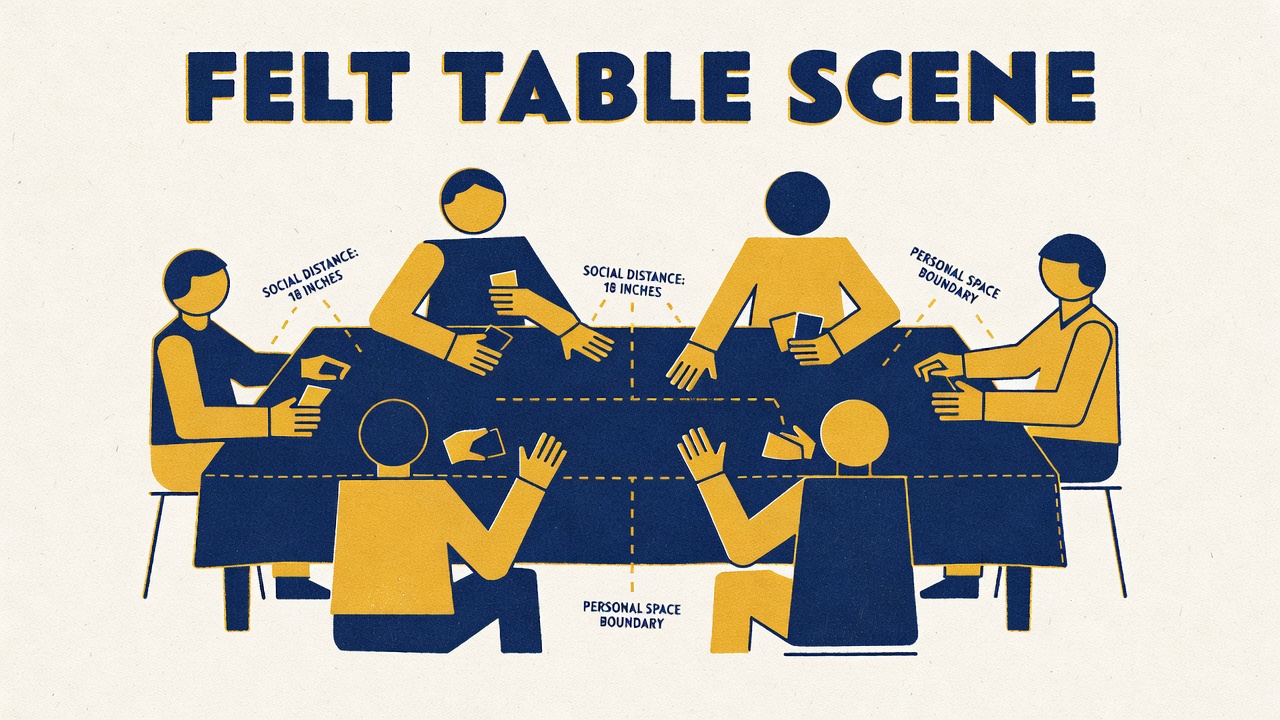
Standing at a blackjack table, you face several conventions that separate the competent from the clumsy. Do not touch the cards with two hands. The dealer handles the cards; your chips stay in the betting box until the round ends. When you want to hit, you scratch the felt with your fingertips, a gesture older than most people in the room. Stand means making a small wave over your cards. Double down means placing chips beside your original bet and taking exactly one more card.
These rules exist because casinos learned long ago that clarity prevents conflict. The more a player understands the physical language of the table, the less likely they are to get caught in arguments, and the longer they stay at the table, and the more they lose. This is not cynicism; it is economics.
When you sit down with a bankroll, you are accepting that you will probably leave with less. The better players accept this fact earlier. They do not chase losses. They do not increase their bet size when losing. They do not treat a blackjack table like an investment opportunity; they treat it like a temporary lease on control.
The Dignity of Managed Expectations
A good player respects the other people at the table. You cheer for the table when it is collective, commiserate when it is collective, and never blame another player for the result of their choice. If the player to your right hits on seventeen and busts out a dealer's ten, you do not comment. Their money. Their decision. Their risk.
The same applies to your own choices. Doubling down on eleven against a dealer's ace is mathematically sound over a thousand hands. On this specific hand, you might lose. The person to your left might think you played it badly. The pit boss might have seen eleven versus ace played a thousand different ways. All of this is noise. You made the decision you could defend.
Here is what the philosophy teaches: gambling in company requires respect for the shared fiction that we are all equal participants in something neither rational nor entirely irrational. You nod to the dealer. You tip when you win small. You stand when the session is done, not when you are ahead, because the game will always be there.
[Topic: Land-Based Casino Etiquette for Blackjack Tables]
The structure of this topic reveals important patterns about how modern gambling operates. At its foundation are several mechanical elements that work together to create an experience.
Core Mechanics
The primary mechanism functions through input variables that determine output outcomes. These inputs include player behavior, house edge, regulatory constraints, and market dynamics. Understanding how each variable affects the overall system is critical.
Historical context provides perspective. This particular topic emerged from earlier gambling practice, evolved through technological change, and now exists in a mature form. The evolution was not linear; regulatory pressure, competitive dynamics, and player demand all shaped the final structure.
The Mathematics
At the quantitative level, specific formulas govern behavior. Expected value calculations determine long-term outcomes. Variance explains the gap between short-term results and theoretical predictions. These mathematical relationships are permanent; they do not change based on luck, superstition, or player belief.
Consider a concrete example that illustrates the principles. A player engages with the system over time. Measurable outcomes accumulate. These outcomes reveal the underlying mathematics more clearly than any single session.
Strategic Implications
A player who understands this topic has genuine advantage over a player who does not. The advantage is not magical; it is just accurate information applied systematically.
Several factors matter more in practice than theory predicts. Execution speed affects results. Decision quality compounds over time. Psychological discipline separates winning from losing play. A player who manages all three elements performs better than a player who manages only one or two.
Practical Application
In real gambling, several considerations affect how this topic applies. The specific casino, the specific game variant, the specific rules all matter. What works universally is the principle: understand the mechanism, calculate the edge, execute with discipline.
The takeaway is straightforward: study this topic seriously, apply it practically, measure your results honestly, and you will have advantage over casual players. This advantage is real, measurable, and sustainable if you maintain the discipline required.
The deeper lesson involves accepting mathematical reality. Some gambling situations are beatable; others are not. The goal is to identify which is which, and only engage in situations where the mathematics favors you or the entertainment value justifies the cost.