Every age crowns its poker variant, and ours has crowned Texas Hold'em.
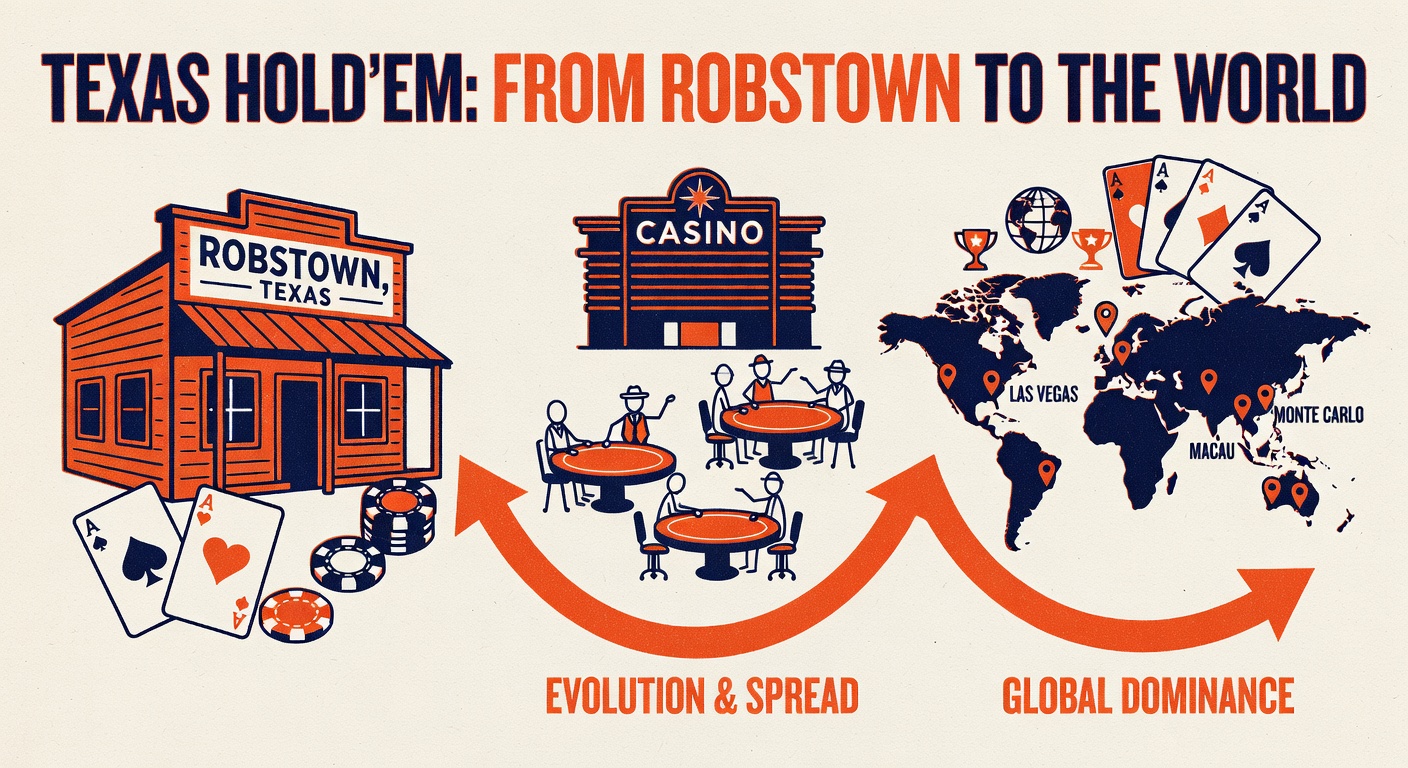
Before the coronation, of course, came a long provincial career. The game, as far as the historical record can be made to confirm, originated in the small town of Robstown, Texas, some time in the first decade of the twentieth century, though the precise year is the sort of detail that invites embellishment rather than confirmation. For decades it remained a regional curiosity, played in saloons and back rooms across east Texas, displaced at every cultural choke-point by five-card draw, seven-card stud, and the various regional variants of each. That Hold'em should have risen from this obscurity to dominate the world's poker rooms is a story worth telling with some care, because the tale is often told badly and always told too quickly.
The 1960s: a Texan export
The game's escape from Texas is generally credited to a small group of players, most prominently Crandell Addington, Doyle Brunson, Amarillo Slim Preston, and Felton "Corky" McCorquodale, who brought the variant to Las Vegas in the mid-1960s. McCorquodale, according to several accounts of uncertain provenance, is the first to have spread the game at the Golden Nugget, where it appeared on the casino's schedule in 1963. The original Vegas audience was small, suspicious, and strongly preferred the established stud-and-draw traditions of the day.
The shift that would matter most, though it seemed minor at the time, occurred in 1967, when the game moved from the Golden Nugget to the Dunes, a property with a larger floor and a more tolerant management. It was at the Dunes that Hold'em began to attract the ambitious recreational player, the visitor from out of state who wished to say, back home in Des Moines or Manchester, that he had played a Las Vegas poker game of obvious depth.
1970: a tournament, accidentally
The World Series of Poker, now a cultural monument, began in 1970 as a small gathering at Binion's Horseshoe, organised at the suggestion of Benny Binion and attended by approximately seven of the era's professionals. The first year's title went to Johnny Moss, by popular vote rather than final hand. Only in 1971 did the main event settle on a no-limit Hold'em format, with a modest field and a modest prize pool. The choice of Hold'em, rather than stud, was not inevitable; it reflected the preferences of the Texans who dominated the early Series and the quiet suitability of the game to tournament play. Unlike stud, Hold'em produces relatively quick hands, rewards aggressive late-stage play, and photographs well, all factors whose significance would become apparent only decades later.
The 1980s: a game in waiting
Throughout the 1980s, Hold'em remained a niche pursuit, respected by professionals and largely unknown to the general public. The cardrooms of California, liberated by a 1987 state attorney-general's opinion that declared Hold'em a game of skill, began to spread the game in earnest, though the total player base was still measured in thousands rather than millions. Doyle Brunson's Super/System, published in 1978 and updated in subsequent editions, served as the canonical technical text, but its readership was limited to the already-initiated.
The game lacked, in this period, the essential ingredient of any cultural conquest: a theatre in which the uninitiated could watch the initiated perform, without having to sit down themselves.
1999 to 2003: the television revolution
The decisive shift arrived in two stages. The first was the introduction of the hole-card camera, a piece of equipment patented by the British producer Henry Orenstein in 1999 and first deployed commercially on the UK programme Late Night Poker in the same year. The innovation was small in engineering terms and enormous in cultural terms: for the first time, a television audience could see what each player held, which transformed poker from a game of impenetrable faces into a drama of visible tension.
The second stage was the 2003 World Series of Poker main event, won by a 27-year-old accountant from Tennessee named Chris Moneymaker, who had qualified for the 10,000-dollar main event by winning a 39-dollar satellite tournament on the online site PokerStars. Moneymaker's victory, aired on ESPN in extensively edited form with the benefit of the hole-card camera, did for Hold'em what no prior event had managed. The audience saw an ordinary man, with an ordinary name, winning 2.5 million dollars in front of seasoned professionals, and was invited to imagine themselves in the same chair.
2003 onwards: the online boom
The effect on participation was immediate and extreme. PokerStars, Party Poker, and Full Tilt Poker experienced sudden and sustained growth, with aggregate online cash-game traffic rising from modest levels in 2002 to a peak of approximately 50,000 concurrent cash-game players by 2006. The overwhelming majority of this traffic was no-limit Texas Hold'em. The other variants, stud in its several forms, Omaha, lowball, retreated to a marginal presence. Newcomers learned Hold'em first, and often learned it exclusively. The game's ascendancy had reached the point of self-reinforcement: players learned Hold'em because that was what others played; and others played it because newcomers knew it.
2006 to 2011: the American disruption
The passage of the Unlawful Internet Gambling Enforcement Act in October 2006 and the subsequent enforcement action known as Black Friday, on 15 April 2011, briefly threatened to derail the American online market and, by extension, the global Hold'em economy. The shutdowns of Full Tilt and the withdrawal of PokerStars from the United States precipitated a contraction in visible traffic, though the underlying cultural hegemony of Hold'em was by then sufficiently entrenched that it survived the disruption. Traffic migrated offshore and to live rooms, which had themselves proliferated during the post-Moneymaker boom.
2011 to the present: consolidation
In the decade and a half since Black Friday, Hold'em's dominance has continued, though its growth has levelled off. The arrival of solver-based study, exemplified by PioSolver and similar tools from the mid-2010s onward, produced a generation of players whose technical mastery exceeds that of the pre-solver era by a measurable margin, at the cost of some of the recreational atmosphere that drove the boom. Streaming platforms such as Twitch have created a new performance layer, in which established professionals broadcast their play live, blending entertainment with instruction. The game continues to be, for most of the world's poker-playing public, the default meaning of the word poker itself.
A closing observation
The conquest was not preordained. Hold'em succeeded because of a series of contingent choices: its adoption in Las Vegas by a small group of Texans, its selection for the World Series in 1971, the patenting of the hole-card camera in 1999, the accidental fairytale of a man named Moneymaker in 2003. Any of these could have gone otherwise, and had one or two of them done so, poker's canonical form today might well be seven-card stud or pot-limit Omaha. That Hold'em won is a fact of history; that it had to win is, on closer inspection, a comforting fiction.